
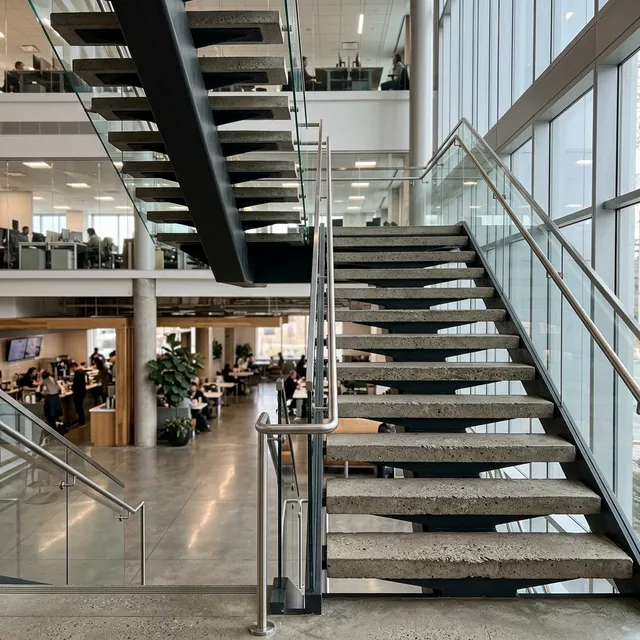
Commercial Floating Staircase Construction in Jacksonville, FL
High-traffic systems for Jacksonville offices, hospitality, and retail. Heavier steel, wider treads, commercial-rated hardware — standard from day one.
Jacksonville Floating Stairs designs and builds commercial floating stair systems to IBC requirements from the start. Commercial occupancies require different structural specs, tread widths, and handrail configurations than residential work. We don't adapt a residential design — we engineer for commercial use from the beginning.
Jacksonville's office market along Butler Boulevard, the Town Center corridor, and the growing Southside district has seen increasing demand for statement staircases in Class A office space. Hospitality projects at the beaches and retail developments in St. Johns Town Center area need floating stair systems that can handle 500 or more users per day without visible wear or structural relaxation.
Commercial floating stairs use heavier steel sections, wider tread depths, and more robust anchor systems than residential work. We specify commercial-grade surface finishes that can be cleaned with industrial cleaners without degrading. We also design for ADA compliance at landings and transitions — not as an afterthought, but as a baseline design requirement.
The permit process for commercial floating stairs involves the building department, the fire marshal, and sometimes a third-party review authority depending on project size. We prepare the documentation and coordinate through all review channels. Delays in commercial projects are expensive — our goal is to get through review without revision requests.
Built for commercial use from day one.
Commercial projects have different requirements. Let's talk through yours.
How We Deliver Commercial Floating Stairs
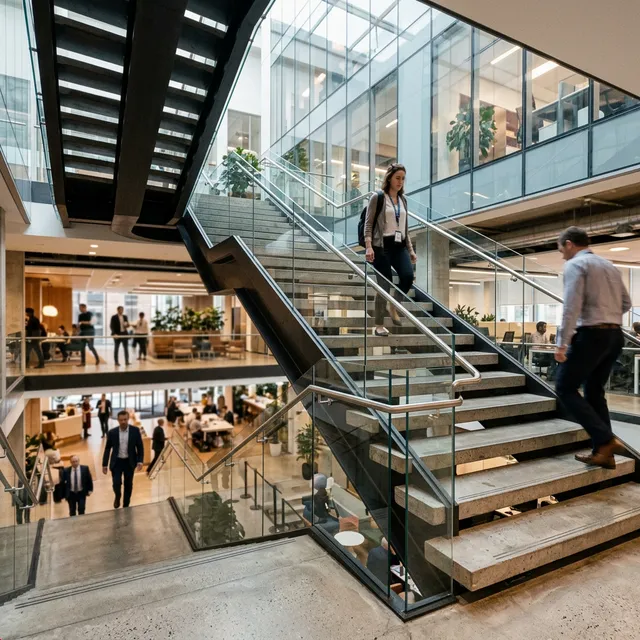
Commercial stairs carry different expectations
Office and hospitality stairs deal with more traffic, more scrutiny from inspectors, and more coordination with other trades than most residential jobs. The finish still matters, but durability and sequencing matter just as much.
We plan commercial systems around use patterns, delivery access, code requirements, and the realities of an active construction site. That keeps the stair from becoming the bottleneck in a larger build-out schedule.
- Traffic and loading assumptions closer to real commercial use
- Coordination with flooring, glazing, lighting, and fire-life-safety requirements
- Installation planning that respects broader tenant-improvement schedules
Commercial Floating Stairs — FAQ
What's different about commercial vs. residential floating stairs?
Do commercial floating stairs need fire-rated construction?
Can floating stairs be used as a required means of egress in Jacksonville?
How do you handle installation scheduling in an occupied office building?
What maintenance does a commercial floating stair require?
Commercial Floating Stairs Built for Daily Use
IBC-compliant engineering. Heavy-gauge fabrication. Jacksonville commercial permit coordination.