
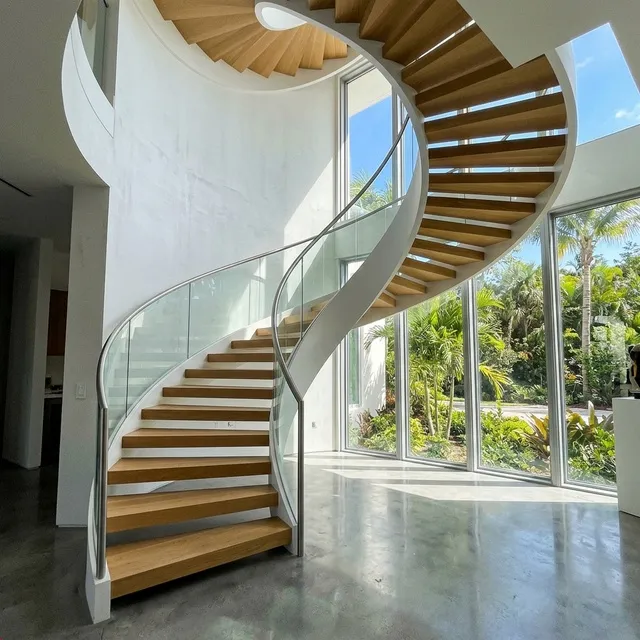
Curved Cantilevered Staircase Design in Jacksonville, FL
Helical and elliptical designs that make vertical circulation the architectural centerpiece. Built to 1/16-inch tolerance.
Jacksonville Floating Stairs designs and builds curved cantilevered staircases — helical and elliptical geometries that most Jacksonville fabricators decline to quote. These projects require more complex geometry, tighter tolerances, and more engineering time than straight systems. We've built the process to handle them without cost overruns or timeline surprises.
A curved cantilevered stair is the dominant architectural feature in any two-story space. Jacksonville's luxury market in Ponte Vedra Beach, the larger homes in St. Johns County, and renovated historic properties in Avondale and Ortega are appropriate contexts for these systems. The design has to function as a daily staircase while serving as a visual statement in entry halls and great rooms.
Geometric accuracy is non-negotiable on curved stairs. The radius is established from the structural centerline, not the tread edge. Each tread has a unique geometry — there are no repeated parts on a true helical system. We model the complete staircase in 3D before fabricating a single piece, then verify that the assembly fits the space before cutting steel.
Curved systems also require more structural consideration at the wall interface. The load path changes at every anchor point as the staircase rotates around its center. We calculate each anchor independently and specify wall reinforcement at each connection zone. This is not a simplified calculation — it's full structural analysis on a stair-by-stair basis.
Curved stairs require a different conversation.
We'll discuss geometry, structural feasibility, and realistic scope before any design work begins.
How We Build Curved Cantilevered Stairs
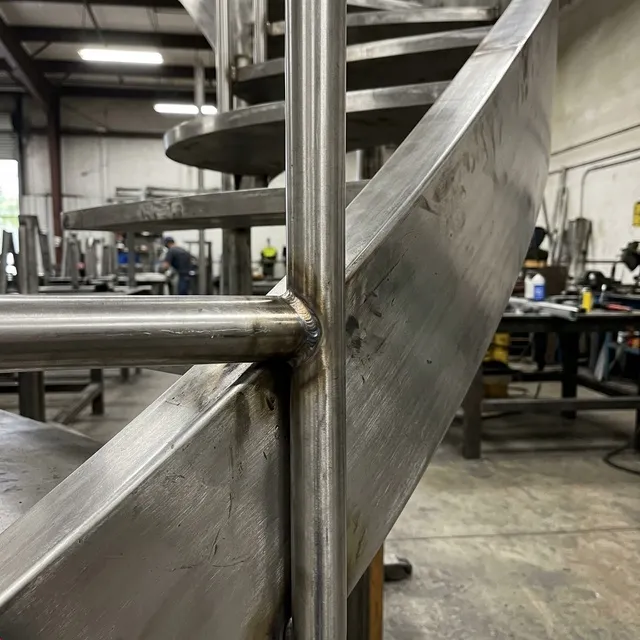
Why curved stairs demand tighter coordination
Curved work removes the margin for sloppy layout. Tread spacing, radius consistency, railing sweep, and landing alignment all show immediately when the stair becomes the focal point of the room.
We use curved stair projects when the home needs a real architectural centerpiece, not just a way to get upstairs. That makes geometry, sequencing, and finish tolerance more important than they are on a simple straight run.
- Curves coordinated with the actual opening, not with a generic radius
- Stringer and railing geometry checked together before fabrication release
- Installation sequencing planned to protect custom finishes during assembly
Curved Cantilevered Stairs — FAQ
Why do most contractors refuse curved cantilevered stairs?
What's the difference between a helical and an elliptical stair?
How much more does a curved cantilevered stair cost than a straight one?
What's the minimum diameter for a helical floating stair?
Can curved floating stairs be permitted in Duval County?
Curved Stairs Built Precisely, Not Approximately
1/16-inch tolerance. Full 3D model. Engineering that handles the complexity most contractors avoid.